How to pace the Queenstown Marathon
The Queenstown Marathon is a largely flat but gently rolling marathon, with about 159 m of climbing and 251 m of descent (a net drop of 91 m). Pace it by even effort: ease back on the few rises and let the descents run, rather than forcing an identical pace on every kilometre.
Saturday 21 November 2026
About 13 weeks away · 93 days · projected from the usual race weekend
Elevation gain
159m
Elevation loss
251m
Net change
-91m
Terrain
Rolling
November
At the gun
5°C
~8:20am start
By the finish
10°C
warms through the morning
Humidity
75%
morning average
Conditions
Ideal
cool, fast racing weather
A thirty-year average for November, not a prediction. The real forecast appears here inside the last nine days.
3:30:00
The same effort as 3:31:03 on flat ground
Target pace
4:59/km
Your goal is already a Queenstown time, so the plan finishes on it. The hills are in the splits below, not in the total: they decide which kilometres are fast and which are slow.
▸Where that comes from
- Your goal for Queenstown
- 3:30:00
- Queenstown’s terrainshapes the splits, not the total
- —
- On the day
- 3:30:00
The net descent gives back about 63 seconds against flat ground.
Queenstown, New Zealand
Hover the map or the profile, the other follows.
This one is won on the back half.
| Marker | Target pace | Clock | Terrain |
|---|---|---|---|
| 1 km | 5:24/km | 5:24 | +14 m |
| 2 km | 4:48/km | 10:12 | -9 m |
| 3 km | 4:41/km | 14:52 | -12 m |
| 4 km | 4:47/km | 19:40 | -8 m |
| 5 km | 4:54/km | 24:34 | flat |
| 6 km | 4:46/km | 29:20 | -9 m |
| 7 km | 5:10/km | 34:30 | flat |
| 8 km | 5:11/km | 39:41 | +7 m |
| 9 km | 4:47/km | 44:28 | -10 m |
| 10 km | 4:26/km | 48:54 | -34 m |
| 11 km | 4:57/km | 53:51 | flat |
| 12 km | 4:44/km | 58:34 | -10 m |
| 13 km | 4:55/km | 1:03:30 | flat |
| 14 km | 5:07/km | 1:08:36 | flat |
| 15 km | 4:53/km | 1:13:29 | flat |
| 16 km | 5:35/km | 1:19:04 | +20 m |
| 17 km | 4:54/km | 1:23:58 | flat |
| 18 km | 4:54/km | 1:28:51 | flat |
| 19 km | 5:24/km | 1:34:15 | +14 m |
| 20 km | 5:14/km | 1:39:29 | +8 m |
| 21 km | 5:10/km | 1:44:39 | flat |
| 22 km | 4:55/km | 1:49:34 | flat |
| 23 km | 5:06/km | 1:54:39 | flat |
| 24 km | 5:03/km | 1:59:43 | flat |
| 25 km | 4:44/km | 2:04:27 | -20 m |
| 26 km | 4:39/km | 2:09:06 | -27 m |
| 27 km | 4:55/km | 2:14:01 | flat |
| 28 km | 4:49/km | 2:18:50 | -7 m |
| 29 km | 4:52/km | 2:23:41 | flat |
| 30 km | 5:24/km | 2:29:06 | +14 m |
| 31 km | 4:53/km | 2:33:59 | flat |
| 32 km | 4:58/km | 2:38:56 | flat |
| 33 km | 4:59/km | 2:43:55 | flat |
| 34 km | 4:58/km | 2:48:53 | flat |
| 35 km | 4:55/km | 2:53:48 | flat |
| 36 km | 5:12/km | 2:59:01 | +7 m |
| 37 km | 5:05/km | 3:04:05 | flat |
| 38 km | 5:06/km | 3:09:11 | flat |
| 39 km | 4:44/km | 3:13:55 | -10 m |
| 40 km | 5:06/km | 3:19:02 | flat |
| 41 km | 5:02/km | 3:24:03 | flat |
| 42 km | 4:56/km | 3:28:59 | flat |
| Finish | 5:12/km | 3:30:00 | +1 m |
Even-effort splits distribute your goal time by the energy cost of each gradient (the Minetti grade-cost model), not an even pace. Wind, heat, turns, and your own downhill tolerance still apply, so run the climbs by feel and stay relaxed on the descents.
These exact splits as a structured workout: one step per kilometre, each with its target pace band (±10 s/km). Your watch prompts every step, so on race day you run the terrain, not the arithmetic.
Garmin needs a cable and a computer. In this file: 43 steps · every km · 3:30:00 goal · even effort · typical November conditions · per-km paces. Change anything above and download again.
You will need a USB cable and a computer. There is no way around that: Garmin has never built a way to send a workout to a watch from a phone, from Garmin Connect, or from any file you can email yourself. Everyone who makes these files, us included, has the same constraint.
- Download the file above on a computer.
- Plug the watch in by USB and wait for it to appear.
- Copy the file into GARMIN/NewFiles. If your watch has no NewFiles folder, use GARMIN/Workouts instead.
- Eject the watch and unplug it.
- On the watch, go to Training, then Workouts. It will be there under the name of this race.
On a Mac the watch mounts as a media device rather than a drive, so you will need a transfer app such as Android File Transfer to see those folders. Windows shows them in Explorer.
Dragging it into Garmin Connect or TrainingPeaks will not work, and it is worth knowing why. .fit is a container that holds several different kinds of file. A recorded run uploads to both of them happily, which is what those drop zones are built for. A workout is a different file type inside the same extension, and neither platform will import one.
Train for this course, not just the distance.
A coach builds the climbs and descents into your plan, and closer to the day you can sit down with Jason and settle how you will run it.
Hardest km
16 km at 5:35/km
Fastest km
10 km at 4:26/km
The coach's read
Far flatter than the alpine setting suggests, the challenge is the scenery, not the gradient. Some of it runs on gravel trail, which costs a little underfoot, so run by feel rather than fixating on the watch and let the lake and rivers carry you to the finish in town.
WHY At 3:30:00, that's about 5:00/km of effort the whole way, the splits below shift with the gradient, not your pace.
Pacing the Queenstown Marathon
A coach's read on how the Queenstown Marathon runs, and how to spend your effort across it.
Kilometre by kilometre
- The climbing that matters: 15.2–16.2 km (+24 m at 2.4%), 0.2–1.3 km (+18 m at 1.6%), 6.2–8.4 km (+17 m at 0.8%). Run these by effort; your pace will and should slow.
- Where you get it back: 24.5–25.6 km (-50 m down), 8.5–9.9 km (-47 m down), 1.4–4.6 km (-38 m down). Let these run without braking or hammering: relaxed, quick feet.
How to pace the Queenstown Marathon
- Read the course before race day. Mostly flat, lake-and-river trails. Far flatter than the alpine setting suggests, the challenge is the scenery, not the gradient.
- Pace by effort, not just the watch. Set the effort you can hold for the whole marathon, then let the pace flex with the ground: a little slower up, a little faster down, the same effort throughout.
- Give the climbs effort, not pace. Let your pace slow on the climbs while holding effort steady; chasing your flat pace uphill is the classic way to blow up. The biggest is around 15–16 km (+24 m).
- Protect your quads on the descents. Stay relaxed and let the descents come to you. Hammering downhill banks a few seconds now and wrecks your legs for the closing kilometres; the model deliberately caps the downhill benefit for this reason.
- Plan your finish. Some of it runs on gravel trail, which costs a little underfoot, so run by feel rather than fixating on the watch and let the lake and rivers carry you to the finish in town.
Queenstown Marathon, answered
- Is the Queenstown Marathon hilly?
- It's largely flat but gently rolling, with around 159 m of total climbing over the 42.2 km and a biggest single climb of about 24 m. None of it is severe, but the rises add up.
- How should I pace the Queenstown Marathon?
- The Queenstown Marathon is a largely flat but gently rolling marathon, with about 159 m of climbing and 251 m of descent (a net drop of 91 m). Pace it by even effort: ease back on the few rises and let the descents run, rather than forcing an identical pace on every kilometre.
- What is the hardest part of the Queenstown Marathon?
- The toughest climb runs roughly 15–16 km, gaining about 24 m at an average 2.4%. Far flatter than the alpine setting suggests, the challenge is the scenery, not the gradient.
- Is the Queenstown Marathon a good course for a PB?
- It can be. It's fast enough for a personal best if you pace by effort and don't fight the rolling sections; just don't expect a dead-flat racetrack.
- How much elevation gain does the Queenstown Marathon have?
- About 159 m of total gain and 251 m of loss over the 42.2 km, modelled from the official route and the SRTM elevation model.
The pacing above is free. The judgement is the part worth paying for.
This page knows the Queenstown Marathon. It does not know you. Two or three weeks out, Jason reads your last twelve weeks and spends 60 minutes going through the day with you, then writes it down so you are not running on memory.
- An honest read on what your training says you can hold
- How to spend your effort across this course, and where it is won
- Fuelling and conditions, decided before you are standing on the line
A$180
One session, one race. Video call, or in person in Sydney.
Your race is still a way off. Worth knowing about now, worth booking about eight weeks out.

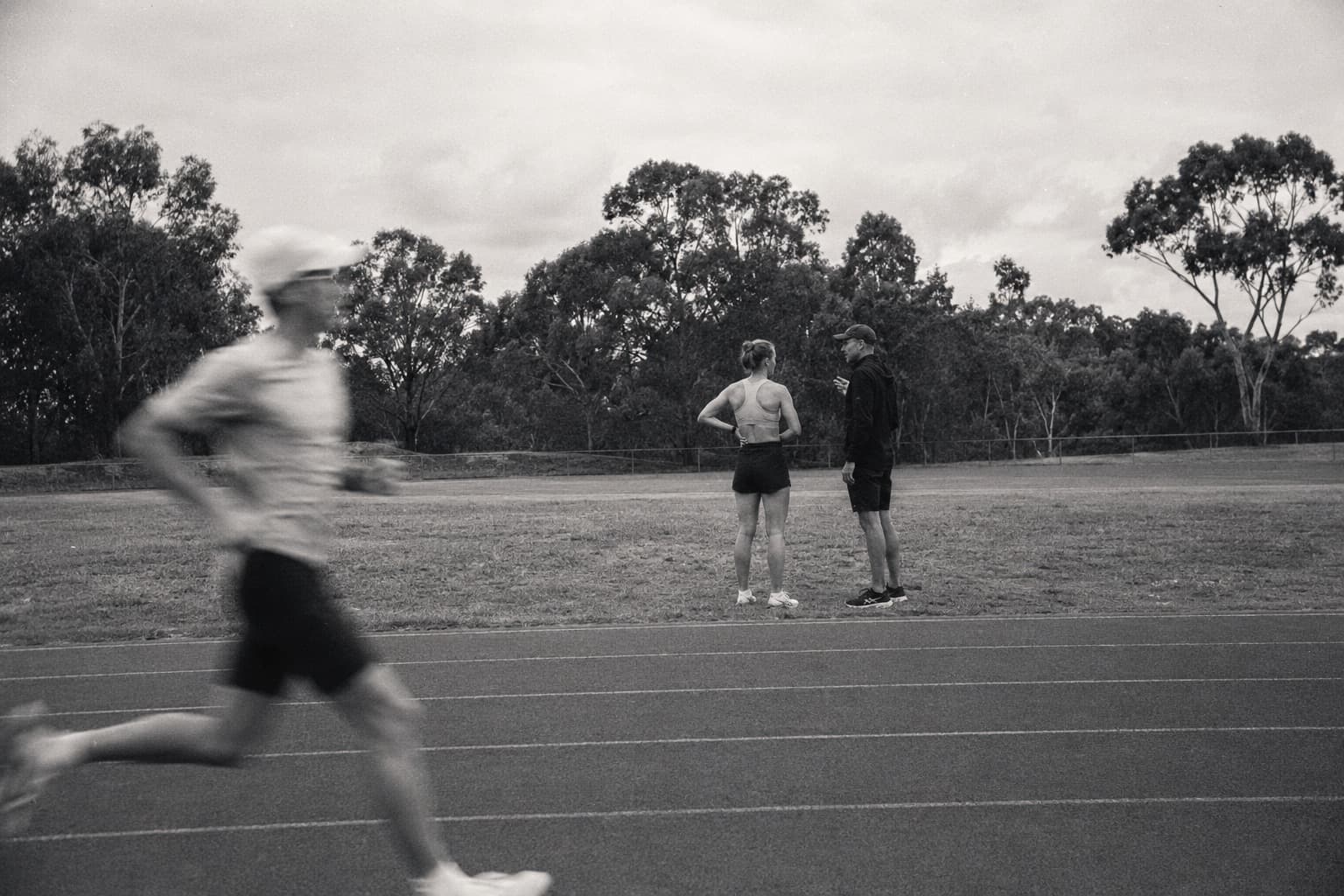
Train for Queenstown. Not just the distance.
A coach builds this course's climbs, descents and race-day pacing into a plan made for you.